Types of Boat Anchors, and When to Use Them
Picking the proper type of boat anchor can mean the difference between a stress-free day on the water or winding up beached on the other side of the lake. There are six boat anchors that are commonly used in recreational boating and while some are more versatile than others, they each serve a different purpose. In this article, we will go over these types of boat anchors and when to use each one.
General Knowledge About Boat Anchors
There are a few things to keep in mind when choosing an anchor and setting it. First, you need to pick the right anchor. This depends on the size of your boat, the type of bottom you’ll be anchoring in, and the current weather or water conditions. Luckily, we’ve broken down each anchor and when to use it, so you can easily make that decision for yourself.
When it comes to dropping anchor, a general rule of thumb is to let out seven feet of line or chain for every foot of water. If there are high winds or the chance of storms, that ratio increases to about ten feet of line per foot of water.
After you’ve dropped the anchor, it’s important to make sure it’s actually set and not dragging. You can check this by gently pulling on the anchor line to feel for steady tension and watching how the boat reacts. Another quick test is to place the back of your hand on the anchor line—if you feel vibration, your anchor is likely dragging.
Below, we’ll go over the different types of anchors, their characteristics, and when they’re most useful.
Danforth Anchor
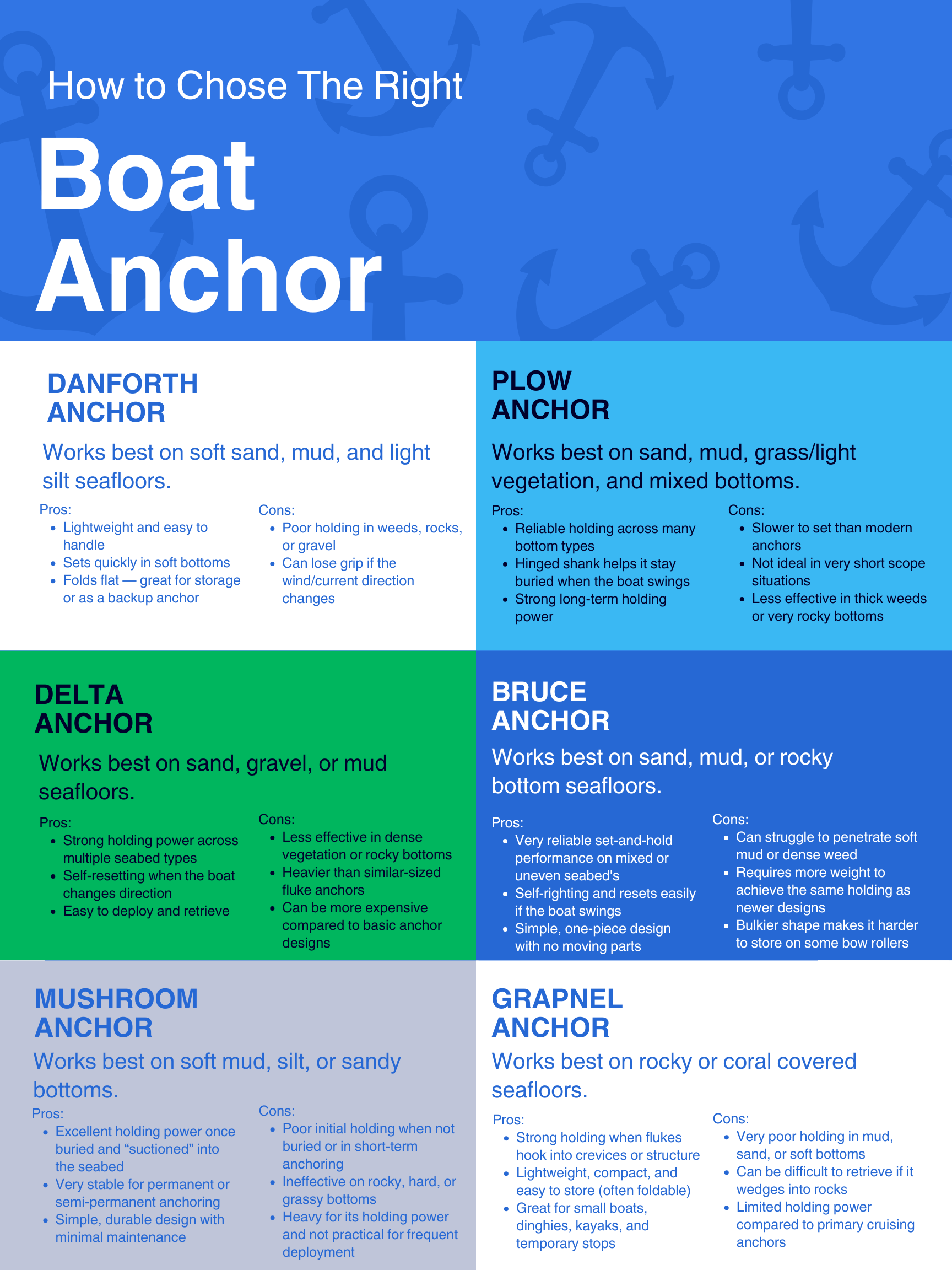
The danforth anchor, also known as the fluke anchor, is one of the most widely used anchors in recreational boating. It is primarily used to hold small to midsize boats. This is because of its lightweight design and strong holding power. It features two wide, flat flukes that pivot on a shank. It works best in soft bottoms such as sand or mud. When the anchor is dragged along the seabed, these flukes dig in deeply and create a strong hold.
Because the anchor is relatively light and its flukes fold flat against the shank, it’s easy to store. This makes it popular amongst center consoles, pontoons, runabouts, and as a backup anchor on larger boats. It sets quickly, but its performance decreases in weedy, gravel, or rocky bottoms where the flukes can’t penetrate the sea floor. It can also lose its grip when the direction of pull changes quickly such as when the current reverses.
Plow Anchor
The plow anchor, which got its name because its shape resembles a farmer’s plow, is one of the most recognizable and time-tested anchor designs in boating. Its design helps it slice into the seabed and maintain a steady hold across a variety of bottom types, making it one of the most versatile boat anchors on the market. The plow anchor also features a hinged shank, allowing it to pivot as the boat swings, helping the anchor stay buried.
The versatility of the plow anchor makes it especially popular among sailors, cruisers, and boats that anchor frequently in different locations. It performs well in sand, mud, grass, and even some gravel conditions, though it can be slow to set compared to more modern anchors. Because of this slowness to set, the plow anchor is not as strong in short-scope situations but is reliable in its long-term holding power.
Delta Anchor
The delta anchor, often called a wing anchor, is a modern take on the plow anchor design. Instead of a hinged shank like in the classic plow anchor, the Delta uses a fixed, triangular shape that allows it to cut into the bottom quickly and hold firmly. Its geometry gives it excellent self-setting behavior, meaning it tends to dig in on the first try rather than skidding along the bottom.
Delta anchors perform especially well in sand, mud, and gravel, and it’s known to stay buried even when the wind or current shifts. That makes them a favorite for cruisers, overnight anchoring, and situations where conditions may change. On many production boats, the Delta is the default factory anchor because it’s reliable, easy to use, and fits neatly on most bow rollers.
Bruce Anchor
The bruce or claw anchor was originally designed for offshore oil rigs. Its shape resembles a three-pronged claw that grips the bottom consistently across many environments, making it a top choice for boaters in areas with rocky, coral, or hard-packed terrain. This is an area that many other anchors struggle in.
Unlike fluke-style anchors that need soft sediment to dig into, the bruce works by working its way into crevices. It typically does not set as quickly as other anchors, but tends to hold, especially in situations where the boat may swing or wind directions change. Because it handles uneven bottoms well and can handle a lot of pull, the bruce/claw is popular with powerboats, fishing boats, and coastal cruisers.
Mushroom Anchor
The mushroom anchor gets its name from its shape which causes it to sink into soft bottoms rather than digging in or hooking like other anchors. It works best in mud, silt, or sand bottoms where it creates a deep suction hold over time. Because of this, mushroom anchors are often used as permanent or semi-permanent moorings rather than everyday anchors you drop and pull regularly.
For short-term anchoring on lakes and calm inland waters the mushroom anchor is a great option for small boats, kayaks, or paddlecraft. If the sea floor is rocky, hard, or weeded, it will not be able to bury itself and get a grip at all.
Grapnel Anchor
The grapnel anchor is compact with multiple tines or “arms” that spread out like a claw. Instead of digging into soft bottoms, the grapnel works by hooking onto rocks, coral, ledges, or debris which makes it ideal for terrains where a traditional anchor can’t dig in.
Its small size and folding capability make the grapnel ideal for dinghies, jet skis, kayaks, paddleboards, and other small crafts. It can be stored easily in lockers or bags and is cheap to replace if it gets stuck. Due to its limited holding power, it is not designed for long-term anchoring, rough weather, or large boats. Also, in sand or mud it typically just drags.
To choose between boat anchors, a captain first must understand their boat, the bottom their anchoring on, and the conditions around them. Each anchor type has strengths and limitations, and knowing when to use the Danforth, Plow, Delta, Bruce, Mushroom, or Grapnel can make the difference between a secure afternoon on the water and a stressful situation. With the right boat anchor, proper scope, and a little practice, you’ll be able to set your boat confidently and enjoy your time on the water without worrying about drifting off.
